













Rooibos Tea Plant
The rooibos tea plant (Aspalathus linearis) is a legume, not a true tea plant, and has nothing in common botanically with Camellia sinensis. Yet it produces one of the most widely consumed herbal beverages on the planet. What makes the rooibos tea plant genuinely unusual is its near-total geographic lock-in: every attempt to cultivate it outside South Africa's Cederberg region has failed. The plant depends on a specific combination of soil chemistry, altitude, and climate that exists in one small corner of the Western Cape and nowhere else.

What Does the Rooibos Plant Look Like?
The rooibos plant is a shrubby, upright bush with fine needle-like leaves on reddish-brown stems. In the wild it grows to between one and two metres tall, and the overall silhouette is loose and open rather than dense. The stems give the plant its name: rooibos is Afrikaans for "red bush," a description that becomes more accurate as the plant matures and the stems deepen from green to a characteristic brick-red.

In spring, the plant produces small, bright yellow flowers that are disproportionately fragrant for their size. Beekeepers in the Cederberg work the rooibos flowering period, and honey harvested from rooibos flowers has a distinct, slightly earthy-sweet character that is noticeably different from fynbos honey produced from other plants in the same biome.
The plant is relatively slow to reach commercial maturity. Under cultivation, the first harvest is typically possible after 18 months, and individual plants remain productive for five to ten years before yields drop enough to justify replanting.
One distinction worth noting for buyers: green rooibos and red rooibos come from exactly the same plant. The difference is entirely in processing. Red rooibos undergoes oxidation after harvest; green rooibos undergoes minimal oxidation after harvest - the exact method of halting oxidation varies by producer but the result is a lighter, grassier flavour than fully oxidised red rooibos. The plant itself is identical.
Why Rooibos Only Grows in One Place
Rooibos grows exclusively in the Cederberg mountain region of South Africa's Western Cape because it requires a very specific combination of growing conditions that does not exist anywhere else in the world. Attempts to establish commercial cultivation in other countries, including Australia and elsewhere in Africa, have consistently failed.

The primary constraint is soil. Rooibos requires highly acidic, nutrient-poor sandy soils with a pH between roughly 4.5 and 6. These soils are characteristic of the fynbos biome that covers the Cederberg and a small adjoining area. Fynbos soils are ancient, heavily leached by winter rains, and contain almost no nitrogen.
That last point matters: rooibos compensates by hosting symbiotic soil bacteria in its root system that fix atmospheric nitrogen directly. These bacteria are native to the region. Introducing rooibos seeds to soil in a different location means introducing them without their bacterial partners, and the results have been consistently poor.
Altitude and climate add further constraints. Commercial rooibos farms sit between 300 and 1,500 metres above sea level. At these elevations, UV radiation is intense, and temperature swings between day and night are significant. Both factors appear to drive the accumulation of the polyphenol compounds that give rooibos its characteristic flavour.
Lower-altitude or more temperate growing conditions produce plants that are structurally similar but flavourally flat. The Cederberg is also a winter-rainfall region: wet from May to August, hot and dry through the growing season. Rooibos has adapted to survive extended dry periods on minimal moisture, but it still needs those winter rains to establish roots. Mediterranean climates in other parts of the world might seem comparable on a map, but the soil chemistry is not.
I find the geographic exclusivity of rooibos genuinely striking when you compare it to other herbal plants. Chamomile grows on six continents. Peppermint is commercially cultivated across dozens of countries.
Rooibos simply does not transfer. That constraint is part of what makes sourcing it worth taking seriously.
How Rooibos Goes from Plant to Tea
Rooibos is harvested by hand in late summer, running from January through March in the Southern Hemisphere. Harvesters cut bundles of stems and leaves, and the freshly cut material is immediately bruised and chopped. The bruising is not incidental: it breaks the cell walls and starts the enzymatic reactions that will drive oxidation.

After chopping, the material is spread into heaps, wetted, and left to oxidise for around 8 to 12 hours. This is sometimes called fermentation in trade literature, though it is enzymatic oxidation rather than microbial fermentation. It falls in the same category of process that turns green tea leaves black, just applied to a completely different plant. During this window, the characteristic red-brown colour develops, and the flavour shifts from grassy and slightly astringent to the sweet, round, lightly vanilla-tinged profile that most people associate with rooibos.
Once the target colour and flavour are reached, the material is spread in the sun to dry, reducing moisture content to around 8-10% to prevent mould during storage and transport. Dried material then goes through sieving to remove fine dust and stems, followed by a heat treatment step for food safety. Most large-scale Cederberg processors use steam pasteurisation for this; smaller cooperatives may use alternative heat treatment methods. Either way, the goal is the same: eliminating potential pathogens without chemical treatment.
The full process from harvest to packaged product typically runs under 48 hours, which is unusually fast for a commodity botanical. That speed matters for quality: prolonged holding of wet, freshly cut rooibos before processing can lead to off-flavours. Good producers move quickly from field to drying yard.
Sustainability and the Future of Rooibos
The European Union granted rooibos Geographic Indication (GI) status in 2021, making it one of the first non-European agricultural products to receive that protection. The practical effect is that only rooibos grown in South Africa's designated production area can be legally sold as "rooibos" in EU markets. Products labelled rooibos from other origins, or manufactured blends with only partial rooibos content, cannot use the name.
GI protection matters for producers because it creates a floor of legal accountability that benefits authentic farming operations. It also matters for buyers: if you are purchasing rooibos in Europe and it carries the GI designation, you have a verified origin claim.
The less positive side of the picture is climate. The Cederberg is experiencing reduced winter rainfall and longer, hotter summers. Drought years measurably reduce rooibos yields.
The plant tolerates dry conditions better than most crops, but not an absence of winter recharge. Smaller independent farmers with less water storage capacity feel drought impacts earlier and harder than large commercial operations.
Certified sourcing programmes address some of these pressures. Rainforest Alliance certification and Ethical Tea Partnership membership both require environmental and labour practice standards that support farm viability over the long term. When we evaluate rooibos suppliers, certification is one of the signals we look for, alongside the basics: colour, aroma, moisture content, and the processing transparency that comes from working directly with cooperatives rather than brokers.
The San people, indigenous to the Cederberg region, have used rooibos for centuries. The 2021 GI award included a benefit-sharing mechanism under the Nagoya Protocol that channels a portion of rooibos export earnings to San communities. This is an unusual and significant step for an agricultural GI, and it adds a layer of provenance to responsible sourcing that goes beyond simple quality checks.
A Plant Worth Understanding
The rooibos tea plant is one of the most geographically constrained commercial beverage crops in the world. Its dependence on Cederberg soil bacteria, acidic sandy conditions, and the specific altitude and rainfall pattern of the Western Cape is not something that can be replicated by adjusting irrigation or adding fertiliser. What you brew in your cup exists only because that specific patch of South Africa exists.
In winter, rooibos is the herbal I reach for in the evening. It feels warming and substantial in a way that lighter herbals do not, and the caffeine-free profile means it does not interfere with sleep. Understanding where the rooibos tea plant actually comes from makes the cup more interesting, not less.
Teas Featured in This Article

Leave a comment
Comments will be approved before showing up.
Also in Valley of Tea Blog | Tea Guides, Origins & Brewing Tips
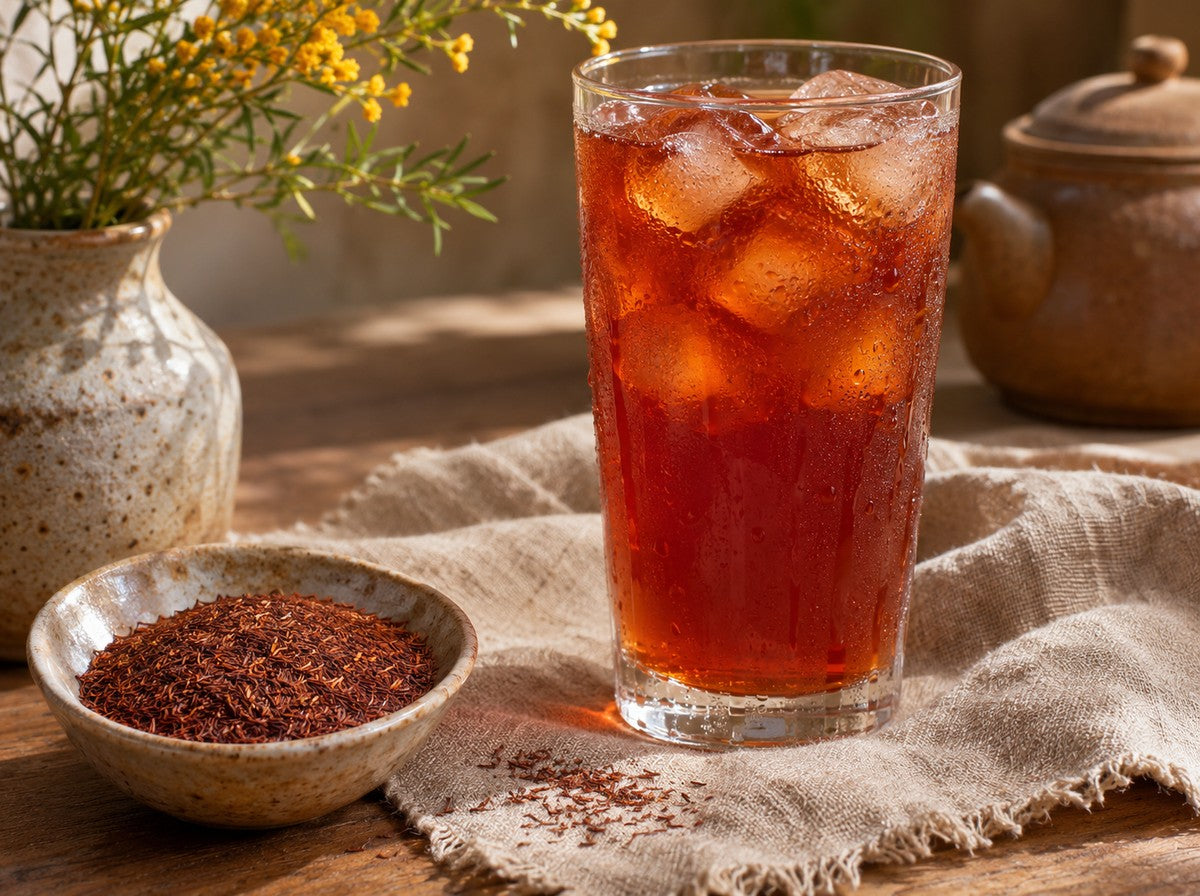

Rooibos Iced Tea: Caffeine-Free Refresher
Learn to make rooibos iced tea two ways: hot-brewed over ice in 15 minutes, or a smoother overnight cold brew, plus flavour additions and storage tips.

Spice Cabinet Organization: A Practical System That Works
Learn how to organize your spice cabinet with a practical system that keeps every jar findable and fresh. Temperature, layout, and audit tips included.

Maca or Ashwagandha for Your Daily Routine
Choosing between maca or ashwagandha? Learn how each root tastes, when to use them, and the best ways to prepare each in tea or drinks.

Wisdom is the path to better tea.
Get our free brewing guide: the right water, heat and timing for every tea we sell. You will also hear it first when new harvests arrive.
No spam. Unsubscribe any time.
Check your inbox.
The guide is on its way.