Tu carrito está vacío

tea drinkers either know intimately or have never encountered at all. There is no middle ground. In Japan, it sits on every dinner table. In Europe, it spent centuries as a staple of folk herbalism before fading into obscurity. And in the world of loose-leaf tea, burdock root occupies a unique position: deeply earthy, slightly sweet, and unlike anything else in your cupboard.
At Valley of Tea, we have been sourcing and tasting teas for over fifteen years, and roots have become one of the most substantial parts of what we carry — over 30 root products in total. Ginger and turmeric lead in volume, but dandelion root, ashwagandha, and ginseng follow close behind. Burdock root sits outside the mainstream of that range, which is exactly why it is worth covering in detail.

This guide covers everything worth knowing about burdock root tea — what it actually is, how it has been used across cultures, what it tastes like, and how to brew it properly. If you have been curious about this root but unsure where to start, you are in the right place.
Burdock (Arctium lappa) is a biennial plant native to Europe and Asia, now naturalized across much of the temperate world. It is the plant responsible for those spiky burrs that cling to your clothes on autumn walks — in fact, the hook-and-loop mechanism of those burrs inspired the invention of Velcro.
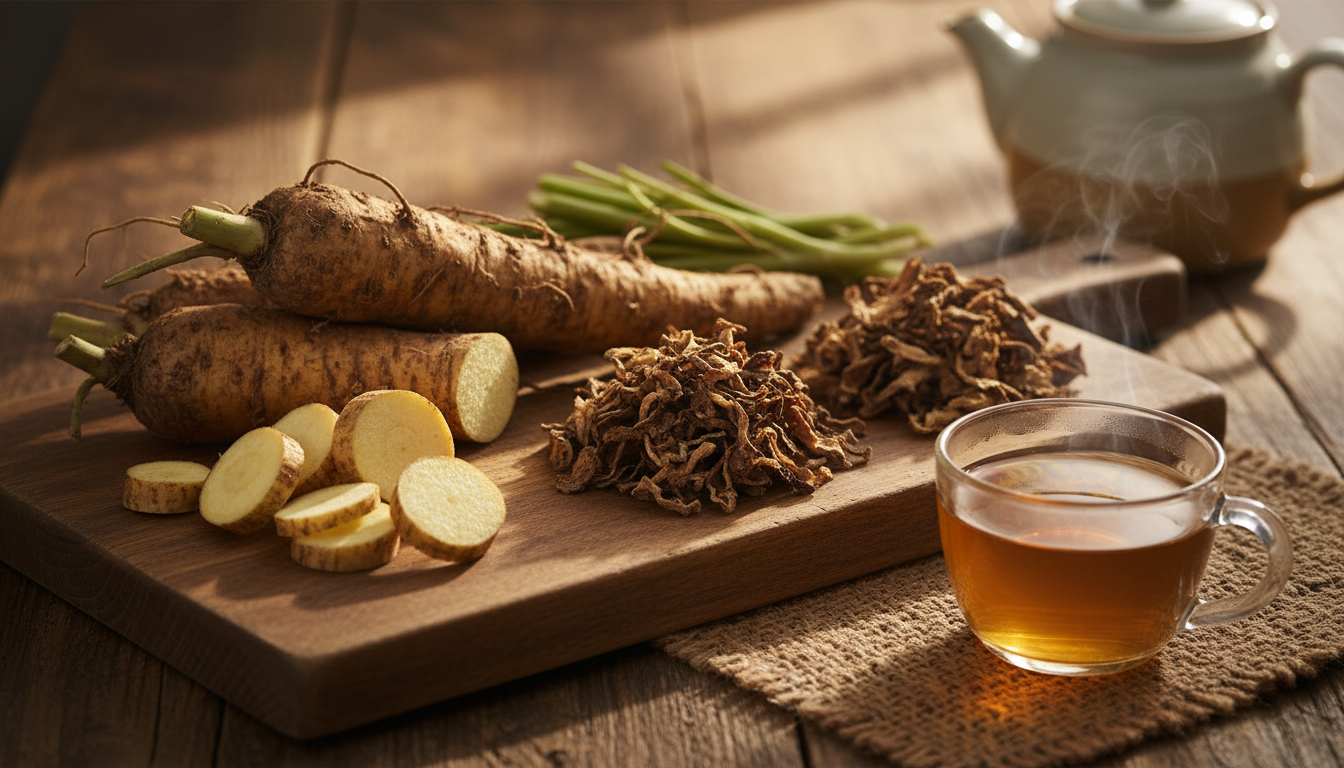
But the part that matters for tea is underground. Burdock produces a long, slender taproot that can reach 60 cm or more in length. This root is harvested, dried, and either sliced or cut into small pieces for brewing. The result is what we call burdock root tea, though technically it is a tisane — an herbal infusion made from a plant other than Camellia sinensis.
The root itself is pale on the inside, with a thin brown skin. When dried, the pieces become hard, woody, and lightweight. Some producers roast the dried root before selling it, which deepens the flavour considerably and adds a toasted, almost coffee-like dimension.

Raw (unroasted) dried burdock root produces a lighter, more vegetal cup. Roasted burdock root yields something darker and more full-bodied. Both have their place, but if you are new to burdock root tea, roasted is usually the more approachable starting point.
Few roots have been as widely used across as many cultures as burdock. Its history stretches back centuries, and the traditions surrounding it reveal just how highly it was regarded. A 2024 review in Natural Products and Bioprospecting confirmed that Arctium lappa has been used in folk medicine across Europe, Asia, and North America for hundreds of years, valued for its anti-inflammatory and metabolic properties. Read the full review on PMC.
In Japan, burdock root is known as gobo and is treated not as medicine but as everyday food. Walk into any Japanese supermarket and you will find fresh burdock root in the vegetable section, right alongside carrots and daikon. It is sliced into thin strips for kinpira gobo, a classic dish of braised burdock and carrot seasoned with soy sauce and mirin.
It appears in soups, stews, and rice dishes. This culinary familiarity means the Japanese relationship with burdock is practical and grounded. It is valued for its texture — firm and slightly crunchy — and for its earthy, mildly sweet flavour.

Drinking burdock root tea (gobo-cha) is a natural extension of this food culture. In Japan, gobo-cha is widely available in tea bags and loose-leaf form and is consumed daily by many people, particularly during colder months. It frames the root as something normal and nourishing rather than exotic or medicinal. It is simply a good thing to eat and drink.
In Europe, burdock root followed a different path. It was one of the most commonly referenced plants in traditional Western herbalism from the medieval period onward. European herbalists valued it as a "blood purifier" — a term that has no precise modern equivalent but generally referred to supporting the body's natural elimination processes.
Burdock root featured prominently in traditional spring tonics, those bitter brews that people drank after long winters of preserved and starchy food. The idea was straightforward: after months of heavy eating, the body needed something cleansing and bitter to reset. Burdock root, along with dandelion and nettle, formed the backbone of these seasonal preparations.
In Britain, burdock survives in popular memory through dandelion and burdock — a traditional soft drink that dates back to at least the 13th century. Originally brewed from actual dandelion and burdock roots and lightly fermented, it was a common household drink for centuries before being replaced by the commercially produced, artificially flavoured version that exists today.

Traditional herbalists in both Europe and Asia also used burdock root externally, as poultices and washes. These applications are largely historical curiosities now, but they speak to the breadth of the plant's traditional reputation.
If you have never tasted burdock root tea, the closest comparison is this: imagine the earthiest thing you have ever drunk, then add a subtle sweetness and a faint woody bitterness underneath. That is burdock root.
The dominant flavour note is earth. Not dirt — earth. There is a distinction. Good burdock root tea tastes like a forest floor in autumn: rich, deep, grounding. It has a minerality that reminds some people of mushrooms, though without any umami character.
Behind the earthiness sits a gentle natural sweetness. Burdock root contains inulin, a type of soluble fibre with a mildly sweet taste. Research published in Food Chemistry confirms that burdock root is among the richest plant sources of inulin-type fructans, containing up to 45% inulin by dry weight — a prebiotic fibre that feeds beneficial gut bacteria. See the full study on PubMed. This sweetness is not obvious on first sip, but it rounds out the cup and prevents the earthiness from becoming monotonous.

Roasted burdock root adds another layer entirely. The roasting process develops caramel and toasted grain notes, pushing the flavour profile toward something reminiscent of roasted barley tea (mugicha) or even a mild, grain-based coffee substitute. Some people who are moving away from coffee find roasted burdock root tea to be a satisfying replacement, not because it tastes like coffee, but because it occupies the same sensory space: dark, warm, roasted, and substantial.
The mouthfeel is medium-bodied. Not thin, but not heavy either. There is no astringency to speak of, which makes burdock root tea pleasant to drink without sweetener.
Here is where burdock root differs from most herbal teas. You cannot simply pour hot water over it and expect good results. Burdock root is dense, woody material. It needs time and sustained heat to release its flavour and beneficial compounds. The method you want is a decoction, not an infusion.
These two roots are frequently mentioned together, and for good reason. They share a long history in traditional herbalism, they are both earthy root tisanes, and they often appear side by side in blends. Dandelion root is among our bestsellers in the root category at Valley of Tea — customers reach for it often, and the comparison with burdock comes up regularly.

But they are distinct.
Flavour: Dandelion root (roasted) leans more toward a bitter, coffee-like profile. It has a sharper bitterness and a slightly burnt caramel quality. Burdock root is earthier, sweeter, and less overtly bitter. In a blind tasting, most people find burdock more approachable.
Body: Burdock root tea has a fuller, rounder mouthfeel. Dandelion root produces a thinner, more watery cup unless brewed very concentrated.
Traditional use: Both were used as "blood purifiers" in European herbalism, and they appeared together so frequently that they almost became a standard pairing. Dandelion was more associated with supporting digestive processes, while burdock had a broader traditional reputation.

Brewing: Both benefit from the decoction method, though dandelion root is somewhat more forgiving of simple steeping if it has been well roasted and finely cut.
The two roots complement each other beautifully. If you enjoy one, you will almost certainly enjoy the other, and blending them together is a tradition that stretches back centuries.
Burdock root is an excellent blending ingredient because of its deep earthiness and mild sweetness. It provides a grounding base note that other ingredients can play off. Some pairings worth exploring:
Burdock and dandelion root. The classic combination. Earthy meets bitter, with enough overlap to create cohesion and enough contrast to keep things interesting. Add a touch of roasted chicory if you want to push further into coffee-substitute territory.

Burdock and ginger. The warmth of ginger lifts burdock's earthiness and adds a spicy brightness. Ginger is the most popular root we sell, and it pairs with almost anything — but it is particularly well-suited to burdock in cold weather. Simmer both together using the decoction method — the ginger needs only the last 5 minutes, so add it partway through.
Burdock and cinnamon. Cinnamon's sweetness and spice complement burdock's earth beautifully. Use a small piece of cinnamon bark rather than ground cinnamon, and add it at the start of the decoction.
Burdock and liquorice root. Liquorice amplifies burdock's natural sweetness and adds body. A small amount goes a long way — liquorice can easily dominate if you use too much. Start with a ratio of 4:1 burdock to liquorice.
Burdock, nettle, and cleavers. A traditional spring tonic combination from European herbalism. Earthy, green, and slightly astringent. Brew the burdock root as a decoction first, then pour the hot liquid over dried nettle and cleavers and steep for an additional 10 minutes.

Not all dried burdock root is equal, and the differences matter for your cup.
Cut size. Look for pieces that are uniformly cut, roughly 5–10 mm. Pieces that are too large take longer to brew and may not release their full flavour. Powder is at the other extreme — it makes straining difficult and can produce a gritty, muddy cup.
Roasted vs raw. Decide which you prefer, or buy both. Roasted burdock root should be an even medium-brown colour without any blackened or burnt pieces. Raw dried burdock root should be pale, beige to light tan, with a clean earthy smell.
Smell. Good dried burdock root smells earthy and slightly sweet. If raw, there should be a clean, root-vegetable scent. If roasted, you should detect toasted grain notes. Any musty, stale, or off odours indicate poor storage or old stock.

Source. Burdock grows across Europe and Asia. Japanese-sourced burdock root (gobo) tends to be of high quality due to the strong culinary demand. European-sourced burdock is equally good when well handled. What matters most is proper drying and storage, not geography.
Organic certification. Since burdock is a root vegetable that grows readily in uncultivated soil, organic certification is meaningful here. It ensures the root was grown without synthetic pesticides, which matters for something you are simmering and drinking.
Storage. Keep dried burdock root in an airtight container away from light, heat, and moisture. Stored properly, it will maintain its quality for 12 to 18 months. After that, the flavour begins to fade, though the root remains safe to use.
Burdock root tea is one of the most distinctive brews you can add to your rotation. Its deep earthiness, gentle sweetness, and satisfying body make it a genuinely interesting drink — not just a novelty, but something you return to because it tastes good.
The key to enjoying burdock root tea is committing to the decoction method. Fifteen to twenty minutes of gentle simmering transforms dried root into something rich and complex. Skip this step, and you will wonder what all the fuss is about. Take the time, and you will understand why this root has been valued across cultures for centuries.
Whether you drink it straight, blend it with dandelion root for a classic pairing, or add ginger for winter warmth, burdock root tea rewards attention and patience — much like the plant itself.
Los comentarios se aprobarán antes de mostrarse.