













Best Tea for Mother's Day: Gifts She Will Love
Best Tea for Mothers Day: Gifts She Will Love
The best tea for Mothers Day gift is not the one with the prettiest tin. It's the one that matches how she drinks tea: strong and malty in the morning, delicate and floral in the afternoon, or caffeine-free after dinner. A 50 g tin of one excellent tea beats a 200 g sampler box of mediocre ones every time. I have spent 15 years sourcing single-origin tea directly from farms in China, Japan, India and Sri Lanka, and this pattern holds every year.

Bulk gift assortments look generous under wrapping paper, but most bundle six or eight teas of average quality just to fill the box. We prefer to send one tea that is genuinely worth her time: a Keemun with real cocoa notes, a Gyokuro shaded for three weeks before harvest, or a chamomile so fresh you can smell it through a sealed tin. That is the difference between a gift she uses once and one she reorders.
This guide splits her Mother's Day tea gift into three groups: classic black tea drinkers, green and white tea drinkers, and anyone who prefers caffeine-free herbal tea in the evening. Pick the category that matches her, then use the presentation section below to turn a 50 g pouch into a gift that does not look like an afterthought.
If she loves classic black tea: Keemun, Assam or Earl Grey
For a mother who drinks classic black tea, choose a single-origin Keemun from Anhui for cocoa and orchid notes, a single-estate Assam for malt depth without the bitterness of CTC dust, or a bergamot-scented Earl Grey built on whole-leaf Ceylon rather than tea fannings.
Keemun from Qimen County in Anhui province is the tea I reach for first when someone tells me their mother "just likes normal tea" but drinks it black, no milk. It has a smoothness that surprises people who expect all black tea to taste like a teabag: cocoa on the front, a faint orchid note on the finish. Brew 3 g at 95°C for 3 minutes and stop there: Keemun turns thin and sharp once you push past the 4-minute mark.
Single-estate Assam is the better pick if she takes milk in her tea. Look for leaf from a named garden, Mangalam and Halmari are two we buy from, rather than a generic "Assam CTC" blend. Garden-specific Assam gives you malty depth and body without the harsh, tannic bitterness that mass-market CTC dust develops once it steeps a minute too long. It is the tea equivalent of buying from one farm instead of a supermarket blend.
Earl Grey earns its place on this list because it is recognizable and most people already know the flavor. The quality gap between a good Earl Grey and a bad one is enormous. A proper Earl Grey starts with real Ceylon black tea, not the crushed dust that fills supermarket bags, and is scented with genuine bergamot oil rather than a synthetic citrus flavoring. Brew it the way you would any black tea: 2–3 g of leaf, water just off the boil, 3 to 5 minutes. We consider it one of the safest picks for the best tea for Mothers Day gifts, since almost everyone already likes the flavor profile: it is the leaf quality that turns a familiar tea into an actual gift instead of a supermarket repeat.
If she prefers green or white tea: Gyokuro, Jasmine Pearls or White Peony
If she prefers a lighter cup, greens and whites are the better category: Gyokuro gives a shaded, umami-rich cup, Jasmine Pearls give hand-rolled green tea scented naturally with fresh jasmine, and White Peony gives a soft, floral white tea from Fujian that is nearly impossible to oversteep.
Gyokuro is shaded for 20 or more days before harvest, which is what gives it that deep, savory character instead of the grassy sharpness you get from an unshaded Sencha. Brew it gently: 5 g of leaf, water cooled to 60°C, just 90 seconds. That low temperature and short steep protect the umami and stop the tea from turning bitter or astringent: a mistake most people make the first time they brew it too hot.
Jasmine Pearls, known as Mo Li Long Zhu, are hand-rolled green tea leaves scented with fresh jasmine blossoms over five to seven nights, then the spent flowers are removed before the tea is packed. The scenting is entirely natural, no added flavoring oil, which is why a good jasmine pearl smells like fresh flowers rather than a candle. Each pearl unfurls slowly in the cup, so it also makes a good gift for someone who enjoys watching the leaf as much as drinking it.
White Peony, or Bai Mu Dan, comes from Fujian province and is made from the Fuding Dabai cultivar, plucked as a bud with two young leaves rather than rolled and fired like most green tea. The aroma is fresh and mellow, floral with a note of cut hay and a light malt undertone underneath. Brew 4 g at 80°C for 4 minutes; White Peony is one of the most forgiving teas to steep, it is genuinely difficult to make a cup that tastes too strong. I like recommending it to people buying for someone who says she "doesn't really like tea": the soft, low-bitterness profile usually changes her mind. Fresher batches show a paler, more silvery down on the buds; darker, browner leaf usually means it has sat too long in storage.
If she likes herbal or caffeine-free: chamomile, lemon balm or lavender
For caffeine-free evening tea, German chamomile gives a clean, apple-blossom cup that is traditionally drunk after dinner across Europe, lemon balm gives a soft citrus flavor, and culinary lavender gives a floral cup that should always be made from Lavandula angustifolia, never an ornamental variety not meant for eating.
German chamomile, botanically Matricaria chamomilla, is the whole-flower version most gift buyers have never actually tried: most tea bags use dust and stem fragments, not the flower head itself. We source ours from Egypt and Croatia, and the origin genuinely changes the cup. The Egyptian flowers are lighter and more delicate with a clean apple-blossom aroma and a pale gold color, while the Croatian ones carry more body and a mild earthy undertone. For a pure chamomile gift meant for the evening, I lean toward the Egyptian batches; for a blend with other herbs, the Croatian holds its own better.
Lemon balm, Melissa officinalis, grown in Europe, is the tea to pick if she finds straight chamomile a bit flat. It has a soft, citrus-forward profile without the sourness of actual lemon, and it steeps quickly: 2 to 3 minutes in water just off the boil is enough. Lemon balm is traditionally used in the evening in parts of Europe, much like chamomile, though we would frame it as a pleasant wind-down cup rather than promise any specific effect.
Culinary lavender, Lavandula angustifolia, is the variety to look for: many lavender plants sold for the garden are bred for scent or color, not for eating, and taste closer to soap than tea. On its own, lavender tea is intensely floral, so most gift-worthy blends soften it with chamomile, rose or a mild black tea base rather than serving it neat. Traditionally used as an evening tea across the Mediterranean, lavender is one to introduce carefully: start with a blend rather than a straight cup, since the floral intensity is not to everyone's taste.
How to gift-wrap and present a single-origin tea
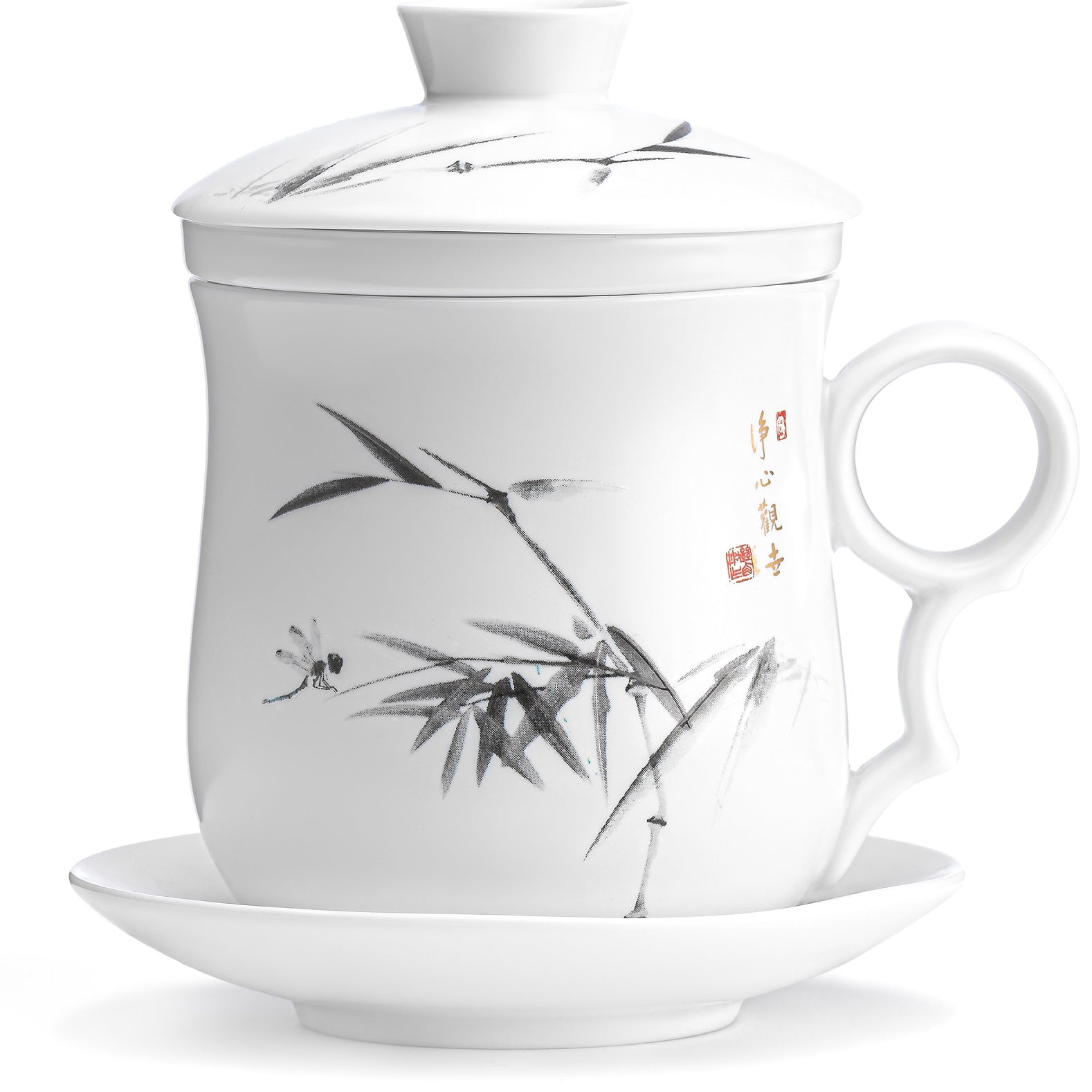
Pair a 50–75 g pouch of loose leaf with simple, practical teaware: a small porcelain gaiwan around 110 ml or a glass teapot with a built-in infuser, plus a handwritten brewing card and a short note on where the tea comes from.
A 50 to 75 g pouch is the right amount for a gift: enough for several weeks of daily brewing, small enough that the tea stays fresh the whole time she is drinking it. Pair it with something she will actually use: a small porcelain gaiwan around 110 ml works for gongfu-style brewing of any of the teas above, while a glass teapot with a built-in infuser is the easier, more forgiving option for someone new to loose leaf. Skip the oversized gift baskets: one good pouch and one piece of teaware beats a hamper of six things she will never open.
Include a handwritten brewing card with the leaf weight, water temperature and steep time for that specific tea: the exact numbers in this guide are a good starting point. Keep it simple: one line per tea, printed or handwritten, tucked inside the tin lid so it is the first thing she sees when she opens it. A card removes the guesswork that stops a lot of loose-leaf gifts from ever getting used; without one, an unfamiliar tea often sits in the cupboard.
Add a short paragraph of origin context: the farmer or garden, the region, and the harvest year if you know it. This is the detail that turns a tin of tea into a gift with a story: knowing her Keemun came from a specific county in Anhui, picked in spring, means more than a generic "sourced with care" label. Even two or three sentences is enough: who grew it, what the harvest season was like, why we chose that particular lot over others. We write this kind of note for our own tins, and it is consistently the detail customers mention back to us.
Frequently Asked Questions
What is the best tea for Mothers Day if I do not know her favorite? White Peony is the safest default: it is soft, floral, low in bitterness even if oversteeped, and works whether she normally drinks black, green or herbal tea. A 50 g pouch with brewing instructions is a low-risk best tea for Mothers Day pick.
Should I choose loose leaf or tea bags for a gift? Loose leaf, whenever possible. Tea bags are usually filled with broken leaf, dust and fannings left over from grading, which lose aroma fast and brew flatter. Whole-leaf tea in a sealed tin keeps its character far longer and simply looks and smells like a gift.
How fresh does the tea need to be to gift? Aim for tea harvested within the last 6 to 12 months, sealed in an airtight tin rather than a paper bag. Green and white teas fade fastest, black tea holds longer: if you're unsure of the harvest date, ask the retailer directly before buying.
Is it better to gift one tea or a sampler set? One excellent tea beats a sampler almost every time. Sampler boxes usually mix five or six teas of average quality to fill the packaging; a single 50 g tin of something genuinely good gets finished, reordered, and remembered: a sampler mostly gets half-tried and forgotten.
Pick one tea she will remember
The best tea for Mothers Day is not the biggest box or the fanciest ribbon. It is the one tea that matches how she drinks tea, brewed the way it deserves to be brewed. Match her to a category first, classic black tea, delicate green or white, or caffeine-free herbal for the evening, and pick one excellent example from that group rather than a mixed sampler.
A single 50 g tin of Keemun, Gyokuro or German chamomile, with a brewing card and a short note on where it came from, is more memorable than a hamper of six teas she will try once and forget. I have watched this play out for 15 years of sourcing tea directly from farms: people remember one exceptional cup far longer than they remember a generic gift basket.
That single choice is the whole point of this guide: narrow the gift down to one tea, one origin, one story, and let the tea do the rest. If you are not sure which category fits her, start with the questions above, pick one tea, and brew her the first cup yourself so she knows exactly how good it can be. It costs less than most sampler boxes and means considerably more.
Teas Featured in This Article


Leave a comment
Comments will be approved before showing up.
Also in Valley of Tea Blog | Tea Guides, Origins & Brewing Tips

Rooibos Iced Tea: Caffeine-Free Refresher
Learn to make rooibos iced tea two ways: hot-brewed over ice in 15 minutes, or a smoother overnight cold brew, plus flavour additions and storage tips.

Spice Cabinet Organization: A Practical System That Works
Learn how to organize your spice cabinet with a practical system that keeps every jar findable and fresh. Temperature, layout, and audit tips included.

Maca or Ashwagandha for Your Daily Routine
Choosing between maca or ashwagandha? Learn how each root tastes, when to use them, and the best ways to prepare each in tea or drinks.

Wisdom is the path to better tea.
Get our free brewing guide: the right water, heat and timing for every tea we sell. You will also hear it first when new harvests arrive.
No spam. Unsubscribe any time.
Check your inbox.
The guide is on its way.