













Pu Erh Tea Origins Processing and Practical Brewing
Pu erh is a fermented dark tea pressed into cakes and aged for years, sometimes decades. It comes exclusively from large-leaf Camellia sinensis var. assamica trees growing in Yunnan, China, and unlike most tea, it changes: some of it slowly over ten or twenty years on a shelf, some of it fast-tracked to drinkability within two months.

We work with growers who still press pu erh the way their families always have, and the first thing I tell anyone new to the category is that the pu erh section is really two categories wearing one name. Raw Sheng pu erh ages naturally, the way a wine cellar ages wine. Ripe Shou pu erh is pushed through a 45-60 day wet-piling process (wo dui) that mimics decades of aging in a matter of weeks. Both start from the same sun-dried mao cha, and both end up pressed into cakes, bricks, or bowls, but the flavour paths diverge almost completely.
This guide covers where pu erh grows, how the two styles are made, what forms it takes, how to brew it two different ways, and how to store it once it is in your cupboard.
Where Pu Erh Grows in Yunnan
Pu erh grows only in Yunnan, China, concentrated across three prefectures: Xishuangbanna, Pu'er (formerly known as Simao, renamed in the 2000s), and Lincang. Growers plant and harvest large-leaf assamica trees between 1,200 and 2,000 metres, where cooler nights, cloud cover, and mineral-rich red soil concentrate the compounds that give aged pu erh its depth. We buy from growers across all three prefectures rather than committing to one, since the flavour differences between them matter in the cup.
Within Xishuangbanna, the names that show up most often on wrappers are Yiwu, Menghai, and Lao Banzhang. Yiwu sits in the east and built its reputation along the old Ancient Tea Horse Trail, the caravan route that once carried pressed tea north into Tibet in exchange for horses and salt. Menghai county, further west, is home to large factory operations, including Menghai Tea Factory, and tends toward blended, multi-mountain productions rather than single-village pressings.
Lincang, further north and west along the Lancang River (the Chinese stretch of the Mekong), has a reputation for bright florality and strong huigan, the returning sweetness that rises in the throat after swallowing. Pu'er prefecture itself, the district the tea and the historic trading town both take their name from, sits between the two, and its material tends to split the difference: generally less overtly floral than Lincang, generally less heavily blended than typical Menghai factory tea.
Elevation matters as much as region. Tea trees above 1,500 metres receive far more ultraviolet light than lowland gardens, and the plant responds by producing more of the compounds tied to bitterness, astringency, and aromatic complexity: the raw material that aged pu erh eventually turns into sweetness. Trees also range enormously in age. Some gardens are recently planted terraces; others are centuries-old semi-wild trees still growing on forest slopes, and material from these older gushu trees commands a steep premium, since yields are low and the trees cannot be replanted quickly.
Village and mountain names on a pu erh wrapper tell you which microclimate, soil type, and tree age went into the cake, and experienced buyers read them the way a wine buyer reads an appellation.
How Pu Erh Is Processed
Every pu erh, raw or ripe, begins the same way: as mao cha, sun-dried loose leaf that has been withered, pan-fired to halt oxidation (kill-green), and rolled to break down the leaf structure. Up to this point the process looks almost identical to green tea production. We buy mao cha from growers who still sun-dry it outdoors rather than with mechanical dryers, and what happens to that raw material next determines whether it becomes Sheng or Shou.
For raw Sheng pu erh, mao cha is steamed until pliable, packed into cloth, and pressed under weight into cakes, bricks, or bowls. Nothing artificial happens to it after that: the cake is set aside to age, and time, air, humidity, and the microbes already living on the leaf do the rest, slowly, over years or decades. This is the traditional method, and the one pu erh used for centuries before any alternative existed.
Ripe Shou pu erh takes a shortcut developed in Yunnan factories during the 1970s to satisfy demand for tea people could drink immediately rather than wait a decade for. After the mao cha stage, the leaf is piled roughly a metre deep on the factory floor, dampened, and covered. Microbial fermentation drives the pile's internal temperature up toward 50-70C, and workers turn it every few days so it ferments evenly rather than scorching in the centre. This wet-piling process, known as wo dui, runs for 45 to 60 days and compresses what would otherwise take twenty years of natural aging into two months. Once fermentation is judged complete, the leaf is dried, sorted, and pressed into cakes the same way Sheng is.
It is worth being direct about one common misunderstanding: an aged Sheng cake never becomes Shou, no matter how many years pass. Sheng deepens and mellows through slow oxidation and natural aging; Shou gets its dark colour, low astringency, and earthy sweetness from wet-pile fermentation. They are two different processes from day one, not two stages of the same tea.
The distinction shows up immediately in the cup. Young Sheng pours pale gold to yellow-green and tastes bright and floral, often quite astringent up front, with that astringency resolving into a sweet aftertaste, huigan, that builds across a session. Shou pours a deep reddish-brown from the first steep and tastes smooth, earthy, and low in astringency, closer to what most newcomers expect a fermented tea to taste like.
Forms Pu Erh Takes
Pu erh comes pressed into a handful of standard shapes, and each one exists for a practical, historical reason rather than aesthetics. Bing cha, the 357-gram round disc, is the form most buyers outside China encounter first: it packs efficiently for the export trade, and 357 grams is the traditional weight said to trace back to stacking seven cakes into a roughly 2.5kg tong for transport along the old tea-horse trade routes.
Tuocha is the bowl-shaped, indented form, usually 100 to 250 grams, originally designed to nest and stack for mule-back transport into Tibet and Sichuan. Bricks (zhuan cha) are rectangular and denser, a shape that made sense when tea itself doubled as a form of currency in border trade, since flat bricks stacked and travelled well. Melon-shaped cakes, tuo cha jin gua, are more of a ceremonial size, often gifted rather than bought for everyday drinking.
Shape affects more than shelf appeal. A tightly pressed cake ages more slowly than a loosely pressed one, because compression limits how much oxygen reaches the leaf interior; a dense brick can taste noticeably younger at the five-year mark than a loosely pressed cake of the same age and origin. Smaller formats, like 100-gram mini cakes or individually wrapped tuocha, trade some aging depth for convenience: they are a sensible way to try three or four different origins before committing to a full 357-gram cake you may or may not enjoy in five years.
We stock cakes rather than loose mao cha for exactly this reason: a common mistake newcomers make is buying unpressed leaf for long-term aging because it looks cheaper. Without compression the leaf dries out and oxidises unevenly, and it rarely develops the layered sweetness a properly pressed cake does. If you plan to age tea yourself, buy it already pressed.
Brewing Pu Erh Two Ways
Pu erh brews well two ways, and which one you reach for depends on time, not skill level. Gongfu brewing uses a high leaf ratio and short, repeated steeps to track how the tea changes infusion by infusion; Western brewing uses less leaf and one longer steep for a simpler, single cup.
For gongfu brewing, break 5 grams from the cake with a pu erh pick, working the point in at an angle so you separate the layers rather than crushing them, and add it to a 100ml gaiwan. Because compressed leaf carries dust and has often travelled through years of storage, rinse it first: pour water at 95-100C over the leaf, let it sit 5-10 seconds, and discard that water before your first real infusion. Start the first steep at around 10 seconds and add roughly 5-10 seconds to each steep after that as the leaf opens up and gives up less flavour per infusion. A good cake will hold its character through 8 or more infusions this way; some quality Sheng and Shou will keep giving usable flavour past 15.
Western brewing is the simpler route for a single mug: 3 grams of leaf per 250ml of water, still near-boiling at 95C, steeped for 3 to 4 minutes. You lose the infusion-by-infusion detail of gongfu brewing, but you get a full, ready-to-drink cup without needing a gaiwan or fair cup. The same leaf can usually be steeped a second time this way too, for 5 to 6 minutes, before it is spent.
One mistake we see often: brewing pu erh at green-tea temperatures. Compressed, aged leaf needs near-boiling water to open properly and extract through its layers; a cooler steep leaves the tea thin and underdeveloped no matter how long you leave it in. If a cup tastes flat rather than earthy or sweet, the water was probably not hot enough, not the tea's fault.
Storing Pu Erh at Home
Store pu erh at 60-70% relative humidity and 20-25C, away from direct light and anything aromatic. Follow those three conditions and a cake will continue developing on a shelf in Europe the same way it would in a Kunming warehouse, just more slowly.
Humidity is the detail people get wrong most often. Below roughly 50%, aging stalls and the leaf dries out. Above 80%, mould risk rises fast. A cheap hygrometer in the storage space is worth more than any container you buy. Keep the tea in its original wrapper or a breathable paper bag rather than sealing it in plastic or a tin; the leaf needs some airflow to age rather than just sit undisturbed. A ceramic jar with a loose-fitting lid, or a simple wooden cabinet, works well once you have more than a cake or two.
Odour is the second-biggest mistake. Pu erh absorbs smells from its surroundings quickly, so keep it away from the spice rack, the coffee, and other scented teas. Give it its own shelf or cupboard if you can. Never refrigerate or freeze pu erh: cold halts aging entirely, introduces condensation risk once the cake warms back up, and the leaf will pick up fridge odours in the meantime.
Keep raw Sheng and ripe Shou separated. Sheng is far more absorbent of surrounding aromas during its long aging window, and storing it next to Shou, or next to any other tea, risks cross-contaminating the flavour you have spent years waiting for. We keep Sheng and Shou on separate shelves in our own storage for this reason, and would recommend home collectors do the same.
If you are only keeping a few cakes rather than building a serious collection, simplicity wins: a breathable paper bag inside a cupboard away from the kitchen will do more good than an elaborate humidity-controlled box you have to fuss over.
Frequently Asked Questions
How much caffeine does pu erh contain compared with coffee.
Pu erh typically contains 30-70mg of caffeine per 250ml cup, depending on cultivar, leaf age, and how long it steeps, well below a standard coffee. Sheng tends to run slightly higher in caffeine than Shou; fermentation during Shou's wet-piling process is thought to break down some of the water-soluble caffeine, though the precise mechanism has not been rigorously quantified. We have noticed customers sensitive to caffeine tend to prefer later steeps in a gongfu session, or Shou over Sheng, since both are noticeably milder.
Can pu erh be re-steeped, and how many times realistically.
A good-quality cake holds up through 8 to 15 infusions using gongfu brewing, with flavour shifting gradually from bright and floral in the early steeps to warm, woody, and mineral in the later ones. Lower-grade material, or Western-style brewing with longer single steeps, exhausts the leaf faster, usually within 2 to 3 infusions.
Does pu erh expire, or is it always drinkable.
Properly stored pu erh does not expire the way fresh food does; it is one of the few teas expected to keep developing for decades. That said, always drinkable is not the same as always good: tea stored too wet can mould, tea stored too dry can turn flat and stall its development, and tea stored near strong odours can pick up flavours that never leave. Sheng drinkers sometimes describe traditional aging as supporting a feeling of digestive comfort or calm, though these are personal observations rather than established medical outcomes, and anyone managing a health condition should check with their doctor before making dietary changes.
Starting With Pu Erh
If you are starting with pu erh for the first time, begin with a ripe Shou. It is the more forgiving choice: it is ready to drink now, and the earthy, warming character works even before you have eaten much, where a young Sheng on an empty stomach can turn astringent and unsettling. Once that flavour feels familiar, do not think of the next step as a single starter cake. I think in longer arcs with Sheng rather than months. I currently have a Sheng cake ageing that is around 5-7 years old, and with Sheng I plan in 5-year increments, not months. That is the real shift for a beginner to make: from drinking Shou for its character today, to setting a young Sheng aside and coming back to it in five years. From there, pu erh stops being one unfamiliar tea and becomes a category worth exploring one cake at a time.
Teas Featured in This Article

Leave a comment
Comments will be approved before showing up.
Also in Valley of Tea Blog | Tea Guides, Origins & Brewing Tips
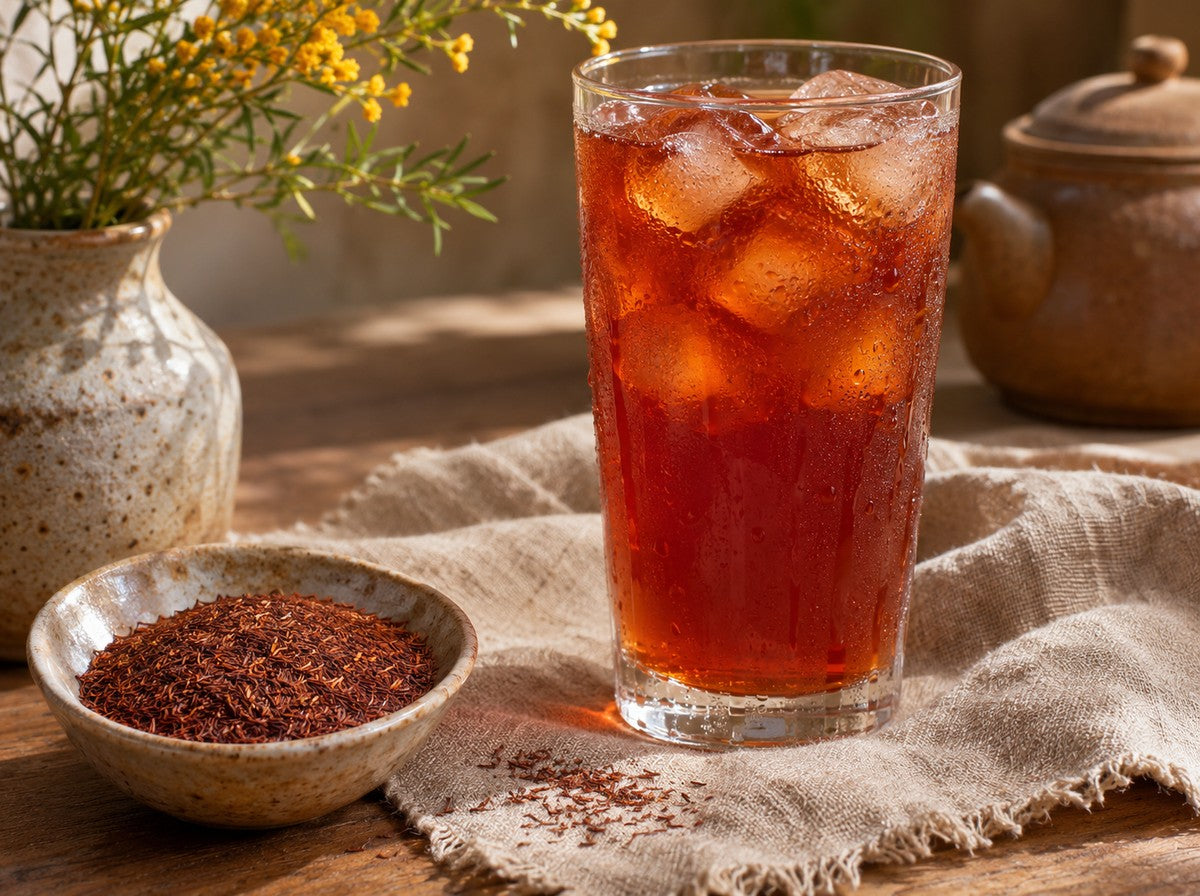

Rooibos Iced Tea: Caffeine-Free Refresher
Learn to make rooibos iced tea two ways: hot-brewed over ice in 15 minutes, or a smoother overnight cold brew, plus flavour additions and storage tips.

Spice Cabinet Organization: A Practical System That Works
Learn how to organize your spice cabinet with a practical system that keeps every jar findable and fresh. Temperature, layout, and audit tips included.

Maca or Ashwagandha for Your Daily Routine
Choosing between maca or ashwagandha? Learn how each root tastes, when to use them, and the best ways to prepare each in tea or drinks.

Wisdom is the path to better tea.
Get our free brewing guide: the right water, heat and timing for every tea we sell. You will also hear it first when new harvests arrive.
No spam. Unsubscribe any time.
Check your inbox.
The guide is on its way.